
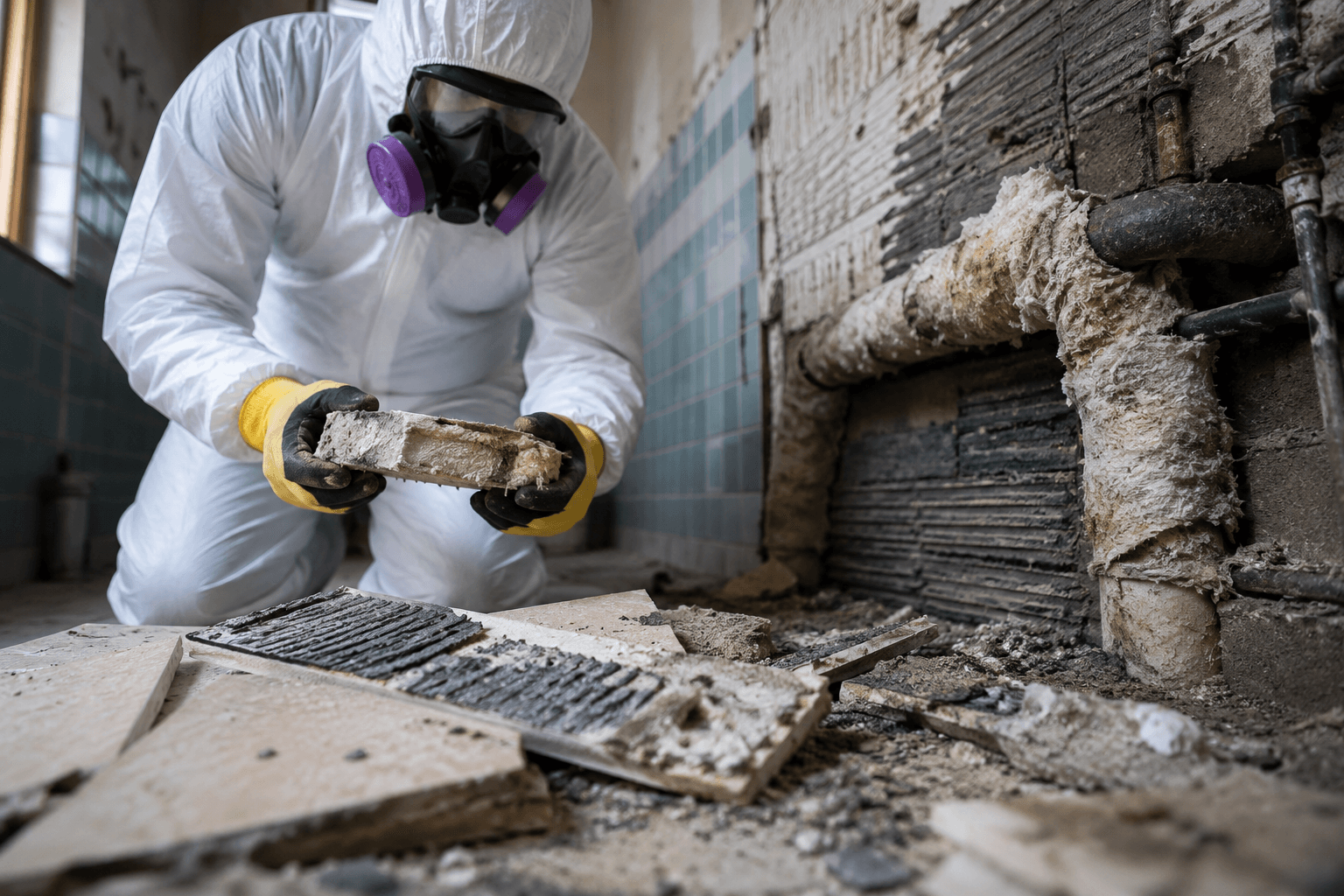
A crew pulls up three layers of kitchen flooring and finds nine-inch tiles set in black adhesive underneath. Work in that room stops that morning.
It isn’t a disaster and it isn’t rare — it’s a normal event in pre-1980 housing, and there’s an established process for it. But it does change your schedule and your budget, and homeowners handle it far better when they knew in advance that it was possible.
Here’s what we look for, what happens when we find it, and what it costs you.
Where it turns up in Chicago-area homes
Asbestos was used across dozens of building products through the 1970s. In the housing we work in, it shows up most often in a short list of places:
- Nine-by-nine vinyl floor tile. The single most common find. Twelve-by-twelve tile from the same era can contain it too.
- Black mastic. The cutback adhesive under old tile and sheet flooring, frequently more of an issue than the tile itself.
- Sheet flooring backing. The paper-like felt layer bonded to old linoleum.
- Pipe insulation and boiler wrap. The chalky white wrap on basement heating pipes, and the material on old boilers and duct joints.
- Textured ceilings. Popcorn and sprayed acoustic finishes.
- Joint compound and some plaster finishes. Less commonly discussed, but present in some pre-1980 work.
- Cement siding and roofing felt. Exterior, but relevant if the project touches them.
Two of these are almost universal in the kitchens and basements we remodel: floor tile with mastic, and pipe wrap. If your home predates about 1980, assume both are possible until they’re ruled out.
You can’t tell by looking
Age and appearance are indicators, not answers. Nine-inch tile is suspect because of when it was made, but plenty of it contains no asbestos, and plenty of unremarkable-looking material does.
The only way to know is laboratory analysis of a sample. Standard turnaround from a local lab is usually a couple of business days, and rush service is often available. That short window is the reason a mid-job discovery costs days rather than weeks.
What we actually do when we find it
The sequence is the same every time:
- Stop work in that area. Not the whole project necessarily — but nothing further gets disturbed in the affected space.
- Isolate it. Leave the material as intact as possible and contain the area. Intact material is not releasing fibres; broken-up material is.
- Sample and test. Through a qualified inspector, with lab analysis.
- Bring you the results and the options. In writing, with the cost and schedule impact of each path.
- Proceed on your decision. Which may or may not involve removal.
What we do not do is keep going and hope. Disturbing suspect material — dry-scraping mastic, breaking up tile, tearing off pipe wrap — is the specific action that turns a manageable situation into a contaminated house.
Removal isn’t always the answer
This surprises people. Finding asbestos doesn’t automatically mean abatement.
Regulation turns largely on whether a material is friable — whether it can be crumbled by hand pressure and release fibres. Pipe insulation and sprayed textures are friable and carry the heaviest requirements. Intact vinyl floor tile is non-friable and behaves very differently.
That gives you three realistic paths:
- Leave it in place. If the material is intact, in good condition, and your project doesn’t need to disturb it, the safest and cheapest option is often to leave it alone.
- Cover it. Encapsulating or floating a new floor over sound old tile is a legitimate, commonly used approach — and one reason we often ask about substrate before quoting flooring work.
- Licensed abatement. Where the material has to go — because it’s friable, damaged, or directly in the path of the work — it’s removed by an Illinois Department of Public Health licensed abatement contractor under containment, with air clearance testing before the space is released back.
That last one is important to be clear about: abatement is specialist licensed work. We don’t perform it, and neither should any general remodeling contractor. We coordinate it, we schedule around it, and we resume when the space is cleared.
What it does to your schedule and budget
A typical mid-job discovery costs a few days for testing, then either nothing further (leave or cover) or an abatement window before work resumes. Occupants usually need to stay out of the affected area during abatement and until clearance testing comes back.
On budget, this is precisely the category of item that can’t be priced before it’s found — which is why we handle it as a documented, priced decision you approve rather than as an open-ended cost. Our approach to fixed written pricing means the scope you signed is the scope you signed; a concealed-condition discovery is a separate, itemised conversation with real numbers, not a blank cheque.
It’s also a good argument for a contingency line in your own budget on any pre-1980 house. Ten to fifteen percent held back for concealed conditions covers this and most of its cousins. Our post on why kitchen remodel timelines slip covers the schedule side of the same problem.
How to avoid the surprise entirely
On projects where we expect suspect material — basement work, old kitchen or bathroom floors, anything involving pipe insulation — the option is to test before demolition rather than during it. A pre-demo survey costs comparatively little and converts an unknown into a line item.
We’ll raise this at estimate stage where it applies. It comes up most in basement remodeling, in kitchens where flooring layers are stacked, and any time we’re opening a wall in an older home.
One more thing worth knowing
If asbestos-containing material is present in your home and stays there, that’s a disclosure item when you sell. It isn’t a barrier — plenty of buyers accept properly managed material in place — but it should be documented rather than discovered.
Keep the lab results and any abatement paperwork. Clearance certificates and waste manifests are exactly the documentation a buyer’s attorney will want to see, and having them turns a scary word into a handled item.
If you’re planning work in an older home in Chicago or the south suburbs and you’d like a realistic view of what might be behind the finishes, we’re happy to walk it with you. See behind the walls of older Chicago bathrooms for what that usually looks like, or request a quote.
Categories

Brewery Taproom Build-Out in Chicago: Floor Drains, Glycol Lines, Licensing Timeline and Budget
Quick answer: A brewery taproom build out in Chicago is driven by what happens under the floor and behind the bar: sloped floors and trench drains in the brewhouse, glycol-chilled draft lines from the cooler [...]

Med Spa Build-Out in Chicago: Treatment Room Layout, Electrical Loads and Real Construction Costs
Quick answer: Med spa build out cost in Chicago usually lands between about $80 and $250 per square foot for construction when you convert a space that was never medical, before equipment. A typical 1,200 [...]

Dental Office Build-Out Cost in Chicago: Plumbing, X-Ray Shielding, Equipment Rough-Ins and Timeline
Quick Answer A dental office build-out in Chicago typically costs $185 to $325 per square foot for construction, which works out to roughly $280,000 to $490,000 for a 1,500 square foot practice and $640,000 to [...]

Wet Room Bathroom Design in Chicago Homes: Layout, Waterproofing and Cost
Quick Answer A wet room bathroom in a Chicago home typically costs between $18,000 and $48,000 for a small to mid-size bathroom, and $45,000 to $75,000 or more for a primary bath. The price is [...]




