
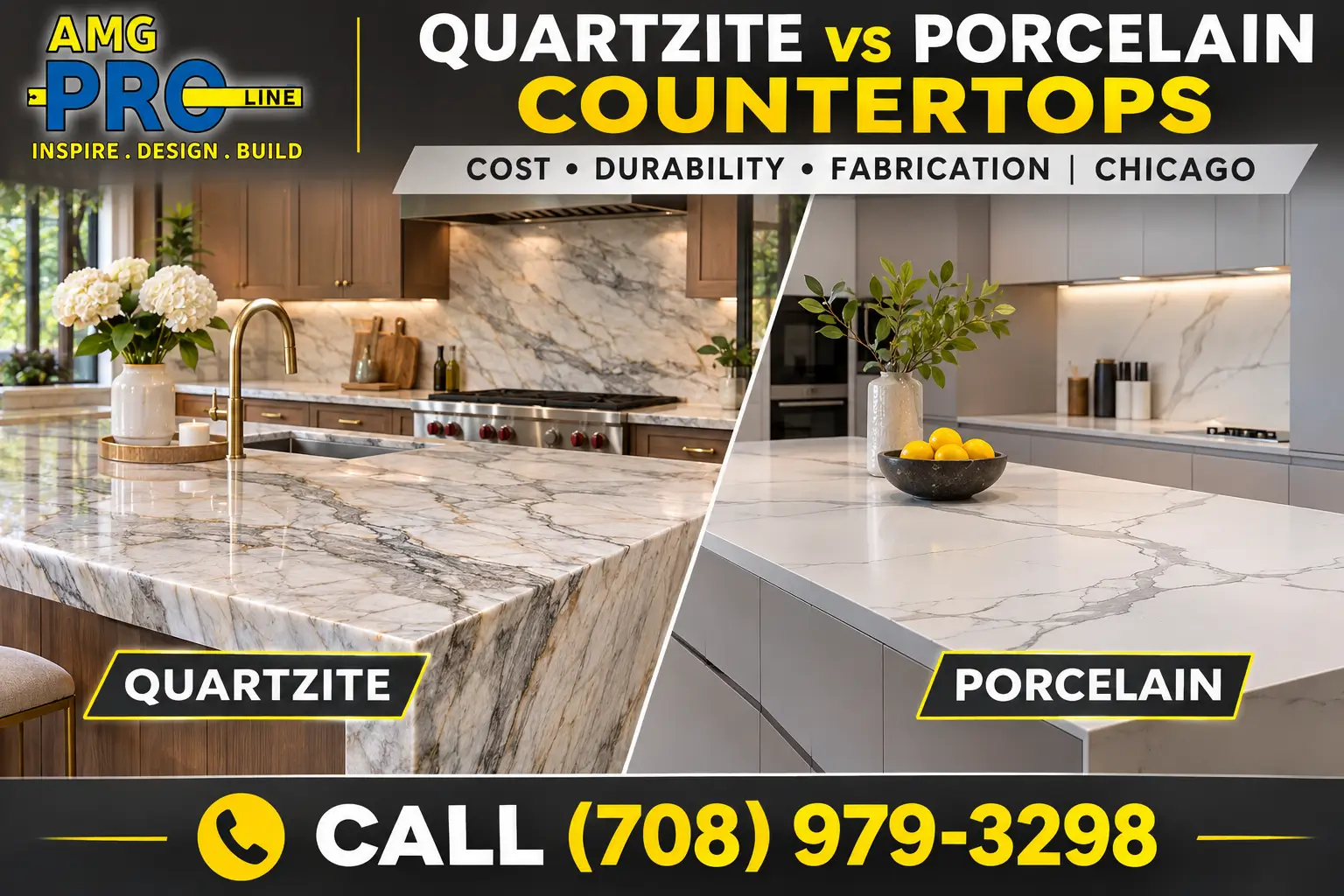
Quick answer: Quartzite vs porcelain countertops comes down to how much you value hardness and natural stone character against low maintenance and stain resistance. Quartzite is a natural stone with excellent heat and scratch resistance, and many slabs look like marble without the same etching problems. Porcelain is a manufactured slab that is extremely stain, heat and UV resistant, with very few seams on large formats. Both are usually priced per square foot installed, and the slab grade, edge profile, sink cutouts and fabrication decide the final total. Get a fixed written quote after templating. Call (708) 979-3298 or request a free quote.
Licensed and bonded in Illinois (License #104.020448) · Remodeling since 2000 · BBB A+ rated · In-house trades · Read our Google reviews here!
Choosing a countertop in Chicago means living with it through hot pans, winter salt on shoes, spilled wine and daily cleaning. Quartzite and porcelain both handle that life well, but they behave differently. This guide compares cost, durability and fabrication so you can match the surface to how you cook, entertain and clean. It is written for homeowners and designers who want a clear comparison before ordering a slab.
This guide goes with our countertop installation service in Chicago. Our crews handle templating, cabinet coordination and installation, and we review the slab with you before fabrication.
Not sure which slab fits your kitchen? Send us your photos and layout, and we will walk you through both options. Call (708) 979-3298!
Quartzite vs Porcelain at a Glance
| Factor | Quartzite | Porcelain |
|---|---|---|
| Material | Natural stone, formed from sandstone under heat and pressure | Manufactured slab, made from fired clay, minerals and pigments |
| Look | Natural veining and variation, often marble-like | Consistent patterns, including stone, concrete and wood looks |
| Heat resistance | Excellent, with hot pans handled well | Excellent, very high heat tolerance |
| Stain resistance | Good, sealing is recommended for many slabs | Very high, low porosity |
| Scratch resistance | Very hard, one of the most scratch-resistant natural stones | Very hard, resists everyday scratching well |
| Seams | Seams depend on slab size and layout | Large formats mean fewer seams |
| Upkeep | Routine sealing and gentle cleaning | Simple cleaning, rarely sealed |
What Drives the Cost
Both materials are priced per square foot installed, but two countertops of the same size can cost very different amounts. These factors move the total most:
- Slab grade. Premium quartzite and rare porcelain patterns cost more than standard ones.
- Thickness. Standard thicknesses carry a different price than thinner or thicker profiles.
- Edge profile. Simple edges cost less than ogee, bullnose or waterfall details.
- Cutouts. Sink, cooktop and faucet cutouts add fabrication time.
- Backsplash and seams. Matching backsplashes and extra seams add labor and material.
Durability in a Chicago Kitchen
- Heat. Both handle hot cookware well. Use trivets for very hot pans on any surface.
- Staining. Porcelain resists wine, coffee and oil very well. Quartzite resists stains well but benefits from sealing and quick cleanup.
- Acid. Quartzite is far less prone to etching than marble, but lemon juice and vinegar should still be wiped up promptly. Porcelain handles acids well.
- Impact. Heavy dropped objects can chip any stone or porcelain edge, so protect corners in high-traffic areas.
- Winter. Chicago winters bring salt and moisture on shoes and in entryways. Both surfaces handle this well when cleaned promptly.
Fabrication and Installation
Fabrication decides how the finished countertop looks and fits. Each material needs different tools and handling.
- Templating. A template is made after cabinets are set, so the slab is cut to the real measurements.
- Cutting. Porcelain needs specialized diamond tools or waterjet cutting. Quartzite is cut with stone tools and is widely fabricated.
- Weight and support. Large slabs need proper cabinet support, and thinner porcelain profiles need careful support around overhangs.
- Seams. Plan seams near sinks or corners, where they are least visible, and match veining where possible.
- Sealing. Many quartzite slabs need sealing at installation and periodically after. Ask your installer for the sealing plan.
Want the slab matched to your kitchen? We template after cabinets are set, so the cut and seams are right the first time.
Care and Maintenance
- Clean with a pH-neutral stone or porcelain cleaner, not harsh abrasives.
- Wipe spills, especially acidic ones, within a few minutes.
- Ask about sealing schedules for quartzite and keep a record of the date.
- Use cutting boards and trivets to protect the surface and edges.
Which One Fits Your Kitchen?
- Choose quartzite if you want the look of natural stone, a warm veining pattern and very high scratch resistance, and you are comfortable with light sealing.
- Choose porcelain if you want the lowest maintenance, the highest stain and UV resistance, and fewer seams on a large island.
- Consider both if you want a stone look in the main kitchen and a porcelain surface on a heavy-use bar or outdoor kitchen.
Timeline
| Stage | Typical time |
|---|---|
| Choosing the slab and approving samples | 1 to 2 weeks |
| Templating after cabinets are set | About 1 week after cabinet install |
| Fabrication | 1 to 3 weeks, depending on the slab and profile |
| Installation and final sealing | 1 day, with sealing as the slab requires |
About AMG Proline
AMG Proline has been building and remodeling in Chicago and the suburbs since 2000. We’re licensed and bonded in Illinois (License #104.020448) and BBB A+ rated. Our own crews handle demolition, cabinet coordination, backsplash and finish work, and we coordinate licensed trades. Learn more about us, see our projects, or read our Google reviews.
Quartzite vs Porcelain Countertop FAQs
Is quartzite better than porcelain?
Neither is better for every kitchen. Quartzite suits buyers who want natural stone character and very high scratch resistance. Porcelain suits buyers who want the lowest maintenance and the highest stain resistance.
Does quartzite need to be sealed?
Many quartzite slabs benefit from sealing, and the schedule depends on the slab. Ask your installer for the sealing plan at installation.
Can porcelain countertops crack?
Porcelain is very hard, but a heavy impact can chip an edge or crack a slab. Support and careful handling during installation reduce the risk.
Which is more expensive, quartzite or porcelain?
It depends on the slab grade, thickness, edge profile and fabrication. Compare quotes on the same specification to see the real difference.
Do porcelain countertops need seams?
Large porcelain formats reduce seams. Very large islands may still need a seam, and the installer will plan its location.
How do quartzite and porcelain handle hot pans?
Both handle heat very well. Use trivets for very hot cookware to protect the surface and any sealant.
Can I use porcelain in a bathroom?
Yes, porcelain vanity tops are used in bathrooms. Ask about thickness and support for the vanity size you choose.
How long does a countertop installation take?
Templating happens after cabinets are set, then fabrication takes about 1 to 3 weeks depending on the slab and profile. Installation itself is usually one day.
How do I get a price?
Call (708) 979-3298 or request a free quote. We review your layout and slab choice and give you a fixed written price.
Get Your Free Countertop Quote
Call (708) 979-3298 · 4711 W 135th St, Crestwood, IL 60418 · Monday to Saturday, 8 AM to 7 PM
Categories

Gut Renovation vs Teardown Chicago: Cost, Permits and Timeline Compared for Older Homes
Quick answer: A gut renovation vs teardown Chicago decision usually comes down to the structure. If the foundation, framing and roof are sound and the home fits your lot and zoning, a gut renovation keeps [...]
Quartzite vs Porcelain Countertops: Cost, Durability and Fabrication in Chicago
Quick answer: Quartzite vs porcelain countertops comes down to how much you value hardness and natural stone character against low maintenance and stain resistance. Quartzite is a natural stone with excellent heat and scratch resistance, [...]

Daycare Center Build-Out in Illinois: Licensing Rules, Safety Requirements and Construction Cost
Quick answer: A child care center build-out in Illinois usually costs about $150 to $250 per square foot in construction when it goes into an existing commercial space. A 3,000 to 6,000 square foot center [...]

Veterinary Clinic Build-Out in Chicago: Kennels, Surgery Suites, Plumbing and Budget
Quick answer: A veterinary clinic build-out in Chicago usually costs about $175 to $300 per square foot in construction. A 2,500 to 4,000 square foot clinic often lands between $440,000 and $1.2 million, before medical [...]


