
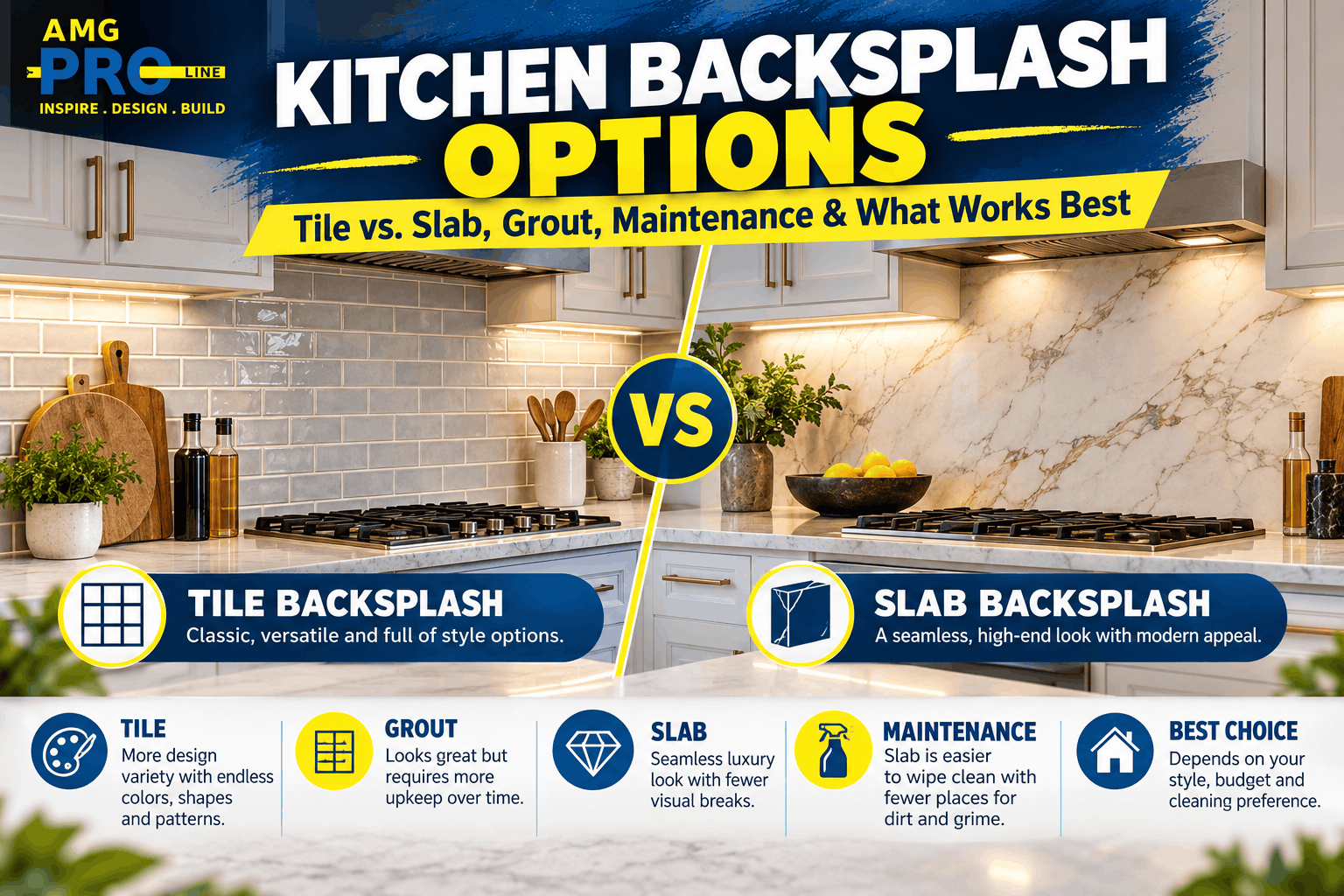
A kitchen backsplash may only cover part of the wall, but it can completely change how the kitchen looks and how easy it is to maintain.
It sits in one of the hardest-working areas of the room.
The backsplash may be exposed to:
- Water
- Cooking grease
- Steam
- Food splashes
- Cleaning products
- Heat
- Daily wiping
That means choosing a backsplash is not only a design decision.
You also need to think about maintenance, grout, heat resistance, stain resistance, countertop colors, cabinet colors and how much visual attention you want the backsplash to receive.
For many kitchens, porcelain or ceramic tile offers the best balance of durability, design flexibility and cost, while slab backsplashes made from quartz, marble or other stone can create a cleaner high-end appearance with fewer grout lines.
The right choice depends on the kitchen.
If you are planning a complete renovation rather than replacing only the backsplash, AMG Proline provides full kitchen remodeling in Chicago, including cabinets, countertops, islands, flooring, lighting, plumbing, electrical work and backsplash installation.
What Is the Best Material for a Kitchen Backsplash?
There is no single material that works best for every homeowner.
Here is a quick comparison.
| Backsplash Material | Maintenance | Grout | Heat Resistance | Best For |
|---|---|---|---|---|
| Ceramic Tile | Easy | Yes | Very good | Most kitchens |
| Porcelain Tile | Very easy | Yes | Excellent | Busy kitchens and durable finishes |
| Glass Tile | Easy | Yes | Good | Decorative or modern kitchens |
| Marble Tile | Moderate | Yes | Very good | High-end traditional kitchens |
| Natural Stone | Moderate | Yes | Very good | Textured or luxury designs |
| Quartz Slab | Easy | Very little | Depends on product/location | Seamless countertop-to-wall look |
| Marble Slab | Moderate | Very little | Very good | Luxury full-height backsplash |
| Granite Slab | Easy to moderate | Very little | Excellent | Durable stone designs |
| Mosaic Tile | Moderate | More grout | Depends on material | Decorative accent areas |
The biggest differences usually come down to three things:
how much maintenance you want, how much grout you want, and how much of a statement you want the backsplash to make.
Why the Backsplash Should Be Chosen With the Countertop
One of the biggest kitchen design mistakes is choosing the countertop and backsplash separately.
They sit directly next to each other.
That means their:
- Colors
- Veining
- Patterns
- Texture
- Finish
- Visual movement
all interact.
If your countertop already has strong veining, adding another heavily patterned backsplash can make the kitchen feel busy.
If your countertop is simple, the backsplash can take on more personality.
A good backsplash should either:
support the countertop
or
intentionally contrast with it.
It should not look like two unrelated materials happened to meet at the wall.
AMG Proline’s backsplash installation service includes planning backsplash materials around countertops and cabinetry so the whole kitchen works together.
Ceramic Tile Backsplash
Ceramic tile remains one of the most common kitchen backsplash materials.
It is popular because it comes in:
- Many colors
- Different shapes
- Glossy finishes
- Matte finishes
- Handmade-look styles
- Subway tile
- Patterned designs
- Decorative shapes
It can work in nearly any kitchen style.
Advantages of Ceramic Tile
Ceramic tile can offer:
- Good stain resistance
- Easy cleaning
- Strong heat resistance
- Many affordable options
- Many grout choices
- Easy design customization
It can work particularly well in kitchens where the homeowner wants visual interest without using an expensive slab material.
Downsides of Ceramic Tile
The tile itself is generally easy to maintain.
The grout requires more attention.
More tile pieces usually mean more grout lines.
That does not automatically make ceramic a bad option, but homeowners who want extremely low maintenance may prefer a larger tile or slab.
Porcelain Tile Backsplash
Porcelain and ceramic are often grouped together, but porcelain is typically denser and less porous.
That makes porcelain a very practical option for kitchens.
Porcelain tile can imitate:
- Marble
- Limestone
- Concrete
- Wood
- Decorative handmade tile
while still providing the performance of manufactured tile.
Why Porcelain Works Well Behind a Range
Porcelain can be especially useful in areas exposed to:
- Cooking splatter
- Steam
- Frequent cleaning
- Heat
It also comes in large-format sizes, which can reduce grout lines.
For homeowners who want a stone appearance without maintaining natural stone, marble-look porcelain can be worth considering.
Subway Tile: Still a Good Choice?
Yes.
Subway tile continues to work because it is simple rather than overly trendy.
The important decision is not only whether you use subway tile.
It is also:
- Tile size
- Color
- Finish
- Grout color
- Installation pattern
Traditional white subway tile with white grout looks very different from:
- Glossy cream tile
- Charcoal grout
- Handmade-look subway tile
- Vertical installation
- Herringbone layout
- Oversized subway tile
The same basic tile shape can therefore produce very different kitchens.
Is White Subway Tile Too Boring?
Not necessarily.
Simple backsplash materials can work very well when other parts of the kitchen already provide visual interest.
For example:
White cabinets + dramatic quartz countertop + simple subway tile
can feel balanced.
But:
Plain cabinets + plain countertop + plain backsplash
may feel unfinished.
The backsplash should be considered as part of the full room rather than judged by itself.
Large-Format Tile Backsplash
Large-format tile has become a strong alternative to small traditional backsplash tile.
Larger pieces mean:
- Fewer grout lines
- Less visual interruption
- Easier cleaning
- A more modern appearance
Large-format porcelain can also imitate natural stone.
This can provide a slab-like appearance without using an actual stone slab.
Installation becomes especially important because large tiles require a properly prepared, flat surface.
Small imperfections behind a traditional tile backsplash can become more noticeable when working with large-format material.
Mosaic Tile Backsplash
Mosaic tile can add:
- Texture
- Pattern
- Color
- Decorative detail
It works well in kitchens where the backsplash is intended to become a design feature.
Mosaics may use:
- Ceramic
- Porcelain
- Glass
- Marble
- Stone
- Mixed materials
The biggest maintenance consideration is grout.
Small pieces create more grout joints.
That means a highly detailed mosaic may require more cleaning than a large tile or slab.
Glass Tile Backsplash
Glass tile can create a clean, reflective appearance.
It can work well in:
- Contemporary kitchens
- Smaller kitchens
- Kitchens that need additional visual brightness
Because glass reflects light, it can make the backsplash feel lighter than some stone materials.
However, installation needs to be precise.
Uneven surfaces, adhesive problems or poorly planned cuts can sometimes be more noticeable through or around glass.
Marble Backsplash
Marble is one of the most recognizable natural stones used in kitchens.
It can create a highly finished look, especially when paired with:
- White cabinets
- Wood cabinets
- Brass fixtures
- Stone countertops
- Traditional cabinetry
Marble is available as both:
- Tile
- Slab
The slab version creates a very different appearance because there are far fewer grout lines.
Does Marble Stain?
Marble is porous and generally needs more care than manufactured tile.
It can be affected by:
- Grease
- Oils
- Acidic foods
- Certain cleaners
Sealing can help reduce absorption, but marble is still a natural material.
Homeowners choosing marble should be comfortable with some maintenance.
Marble Tile vs. Marble Slab
Both use the same general material, but the finished look is very different.
Marble Tile
Usually provides:
- Lower material cost
- More grout
- More pattern breaks
- Smaller individual pieces
Marble Slab
Usually provides:
- Continuous veining
- Minimal grout
- High-end appearance
- Easier wiping across a large surface
- More complex fabrication and installation
The right choice depends on budget and design goals.
Quartz Backsplash
Quartz countertops are common in remodeled kitchens, and some homeowners continue the same material up the wall.
This creates a quartz slab backsplash.
The result can look very clean because:
- Countertop and backsplash match
- There are very few grout lines
- Veining can continue vertically
- The kitchen feels more seamless
This design works especially well in modern kitchens.
Can You Use the Same Quartz for the Countertop and Backsplash?
Yes, and it can create one of the cleanest backsplash designs.
For example:
Quartz countertop → same quartz carried 18 inches up wall
or
Quartz countertop → same slab continued all the way to upper cabinets
Both approaches reduce the number of different materials in the room.
This can be especially useful when the quartz already contains visible veining or pattern.
What Is a Full-Height Backsplash?
A traditional backsplash commonly runs from the countertop to the bottom of the upper cabinets.
A full-height backsplash takes the material farther.
It may extend:
- From countertop to upper cabinets
- Countertop to ceiling
- Around a range hood
- Across an entire feature wall
The material may be:
- Tile
- Marble
- Quartz
- Granite
- Porcelain slab
Full-height backsplashes can make the kitchen feel more intentional because there is less painted wall breaking up the design.
Is a Full-Height Backsplash Worth It?
It can be.
The advantages include:
- Strong visual impact
- More wall protection
- Easier cleaning than painted drywall
- A finished custom appearance
The main downside is cost.
There is simply more material and more installation involved.
If using slab stone, fabrication and handling may also become more complex.
Should the Backsplash Go All the Way to the Ceiling?
Not automatically.
Ceiling-height backsplash material works best when there is a reason for it.
Good locations include:
- Behind a range hood
- Around open shelving
- On a feature wall
- Around a window
- In kitchens without upper cabinets
Covering every possible wall with statement tile or stone can sometimes overwhelm the room.
The design needs breathing room.
Tile vs. Slab Backsplash
This is one of the biggest backsplash decisions.
Choose Tile If You Want:
- More design options
- Lower material cost in many cases
- Patterns
- Color
- Handmade appearance
- Easy customization
Choose Slab If You Want:
- Fewer grout lines
- Easier wiping
- Continuous veining
- Modern appearance
- A countertop-to-wall transition
- Strong visual impact
Neither is automatically better.
The question is whether you prefer detail and pattern or clean continuous surfaces.
What Is the Easiest Kitchen Backsplash to Clean?
Generally, materials with fewer grout lines are easiest.
A slab backsplash can be extremely easy to wipe because there are few interruptions in the surface.
Large-format porcelain tile can also be easy to maintain.
Traditional small tile has more grout joints, which means more lines that may eventually need cleaning.
If easy maintenance is one of your highest priorities, consider:
- Quartz or stone slab
- Large-format porcelain
- Large ceramic tile
- Traditional subway tile
- Highly detailed mosaic
The exact order can change depending on material and grout selection.
Is Grout Hard to Keep Clean?
Grout requires more maintenance than most tile surfaces because it creates recessed joints between pieces.
Areas behind a range can receive:
- Grease
- Oil
- Sauce
- Steam
Areas near a sink can receive:
- Water
- Soap
- Food residue
Choosing the correct grout and properly maintaining it can make a major difference.
AMG Proline handles the complete backsplash installation process, including surface preparation, layout, grouting and sealing where appropriate.
What Grout Color Should You Choose?
Grout color affects how visible the tile pattern becomes.
Matching Grout
For example:
White tile + white grout
creates a softer continuous appearance.
Contrasting Grout
For example:
White tile + dark gray grout
makes every tile more visible.
Neither is better.
The decision depends on whether you want the grout to disappear or become part of the design.
Does Dark Grout Stay Cleaner?
Dark grout can hide some staining better than very light grout, but it is not maintenance-free.
Grease, mineral deposits and cleaning residue can still become visible.
Choose grout primarily for the design and expected maintenance—not because you think a dark color will never need cleaning.
What Backsplash Works Best Behind a Stove?
The area behind a range receives more exposure to:
- Heat
- Oil
- Steam
- Food splatter
- Frequent cleaning
Good options include:
- Porcelain tile
- Ceramic tile
- Appropriate natural stone
- Granite
- Certain slab materials
The exact material should also be appropriate for the appliance installation and manufacturer requirements.
Ease of cleaning becomes especially important here.
Should You Put a Different Backsplash Behind the Stove?
Sometimes.
Creating a focal area behind the range can work when the rest of the backsplash is simple.
For example:
Simple subway tile throughout + framed decorative tile behind range
can create a clear focal point.
However, homeowners should be careful not to combine too many competing patterns.
If the countertop already has dramatic movement, a separate patterned range feature may make the room feel overly busy.
What Backsplash Works Best With Quartz Countertops?
Quartz comes in many patterns, so the answer depends on the countertop.
Busy Quartz
If the quartz has strong veining:
Choose a simpler backsplash, such as:
- Plain subway tile
- Large-format neutral porcelain
- Matching quartz slab
Simple Quartz
If the countertop is mostly solid:
You have more freedom to use:
- Patterned tile
- Handmade tile
- Marble-look porcelain
- Decorative shapes
The countertop should usually lead the design because it occupies a large visual surface.
What Backsplash Works Best With Granite?
Granite often contains:
- Multiple colors
- Mineral variation
- Strong natural movement
Because granite can already be visually busy, simple backsplash materials often work well.
Consider:
- Neutral ceramic tile
- Simple porcelain
- A quiet stone
- A color pulled from the granite
Trying to match every color inside granite usually creates too much visual activity.
What Backsplash Works Best With Marble Countertops?
Marble already has recognizable veining.
You can either:
Keep It Simple
Use plain tile so the marble remains the focal point.
Continue the Marble
Use matching marble slab or marble tile for a cohesive appearance.
Be cautious when mixing two unrelated veined materials.
One strong stone pattern is often enough.
What Backsplash Works With White Cabinets?
White cabinets give you flexibility.
Popular combinations include:
- White tile
- Marble
- Warm beige tile
- Gray porcelain
- Handmade ceramic
- Black or charcoal accents
- Matching countertop slab
Because white cabinetry is neutral, the backsplash can either remain quiet or become the design feature.
What Backsplash Works With Wood Cabinets?
Wood cabinets already add warmth and grain.
Backsplash materials that often complement wood include:
- Cream tile
- Warm white tile
- Soft stone colors
- Green tones
- Natural stone
- Light porcelain
The undertone matters.
Warm wood paired with a very cool white may sometimes feel disconnected.
Should the Backsplash Match the Cabinets or Countertop?
It does not need to exactly match either.
A better goal is coordination.
Think of the kitchen as three major surfaces:
- Cabinets
- Countertops
- Backsplash
Usually one of these should carry the strongest visual movement.
The other two should support it.
For example:
Wood cabinets + simple white quartz + patterned backsplash
works because only one surface carries a strong pattern.
Another example:
White cabinets + dramatic quartz + plain backsplash
allows the countertop to become the visual focus.
Should You Choose the Backsplash Before the Countertop?
Usually, choose the countertop first.
Countertops are:
- More expensive
- Harder to change
- Larger visual surfaces
- More limited in exact slab pattern
Backsplash materials are usually easier to coordinate afterward.
A common order is:
- Cabinets
- Countertops
- Backsplash
- Paint
- Decorative hardware and accessories
That makes it easier to coordinate undertones and patterns.
Should Backsplash Tile Be Glossy or Matte?
Both can work.
Glossy Tile
Can:
- Reflect more light
- Feel bright
- Wipe easily
- Make colors appear deeper
Matte Tile
Can:
- Feel softer
- Reduce reflections
- Work well in natural or contemporary designs
One is not universally easier or better.
Choose based on the overall kitchen style and maintenance expectations.
Should a Small Kitchen Use a Simple Backsplash?
Often, yes.
Small kitchens already contain many visible elements close together:
- Cabinets
- Appliances
- Countertops
- Hardware
- Lighting
A backsplash with too many competing patterns can make the space feel crowded.
Larger tile, simple colors or continuous slab material can make the design feel calmer.
That does not mean a small kitchen must be boring.
A single distinctive material used consistently can still create personality.
Can a Backsplash Make a Kitchen Look Bigger?
It can help.
Several choices can create a more open appearance:
- Light-colored tile
- Fewer grout lines
- Larger tile
- Reflective finishes
- Full-height installation
- Consistent countertop and backsplash material
Visual continuity tends to make surfaces feel less broken up.
Should the Backsplash Stop at the Cabinets?
Usually the backsplash terminates at a natural architectural line.
Possible stopping points include:
- Upper cabinet edge
- Countertop edge
- Wall corner
- Door opening
- Window
- Range hood
There is not one universal rule.
The important thing is making the endpoint look intentional.
A backsplash that stops randomly in the middle of a wall usually looks unfinished.
What Happens Around Electrical Outlets?
Outlets are one of the details that separate a clean backsplash from a poorly planned one.
Tile layout should account for:
- Outlet locations
- Switches
- Corners
- Cabinet edges
- Windows
Poor planning can create:
- Tiny tile slivers
- Uneven cuts
- Misaligned grout lines
- Awkward pattern interruptions
Professional installation should plan these cuts before setting the tile.
Should Outlets Be Moved for a New Backsplash?
Sometimes homeowners move or reconfigure outlets during a larger kitchen remodel for a cleaner appearance.
This makes the most sense when:
- Cabinets are being replaced
- Electrical work is already happening
- A full-height slab backsplash is planned
- The current outlets interfere with the new design
Electrical changes should be coordinated before backsplash installation.
This is one advantage of planning the backsplash as part of a complete kitchen remodel instead of treating it as a completely separate decorative project.
Does the Wall Need to Be Perfect Before Backsplash Installation?
The wall needs to be properly prepared.
Depending on the existing condition, prep may include:
- Removing old tile
- Scraping adhesive
- Drywall repair
- Flattening uneven areas
- Cleaning grease
- Replacing damaged wallboard
- Proper preparation around wet areas
The finished backsplash is only as good as the surface behind it.
Trying to hide a badly uneven wall with tile often creates more installation problems.
Can Backsplash Be Installed Over Painted Drywall?
In many typical kitchen applications, tile can be installed over properly prepared drywall.
However, the wall needs to be:
- Sound
- Flat
- Clean
- Dry
- Free of loose paint
- Free of grease
Damaged or moisture-affected drywall should be addressed before installation.
The exact preparation also depends on the backsplash material and location.
Can You Install New Backsplash Over Old Tile?
It is sometimes technically possible, but that does not automatically make it the best choice.
Installing over old tile can create issues with:
- Wall thickness
- Outlet depth
- Countertop transitions
- Cabinet edges
- Adhesion
- Existing loose tiles
- Unevenness
Removing the old backsplash allows the installer to inspect and prepare the wall underneath.
That often provides a cleaner starting point.
When Is Backsplash Installed During a Kitchen Remodel?
Backsplash is typically installed after:
- Cabinets
- Countertops
are already in place.
That allows the backsplash to be measured and fitted precisely between the countertop and upper cabinets.
It also allows cuts around:
- Outlets
- Windows
- Range hoods
- Cabinets
to be planned around the actual finished dimensions.
AMG Proline includes backsplash and tile as part of its complete Chicago kitchen remodeling service.
Should the Backsplash Be Installed Before or After Countertops?
Usually after the countertops.
The countertop establishes the bottom line of the backsplash.
Installing the backsplash afterward allows the material to fit properly against the finished countertop.
This is especially important with slab backsplashes because precise measurements matter.
Can You Replace a Backsplash Without Remodeling the Entire Kitchen?
Yes.
A backsplash can often be updated as a standalone project when:
- Cabinets are staying
- Countertops are staying
- The layout is not changing
- Walls are in good condition
Replacing an outdated backsplash can noticeably change the look of a kitchen without rebuilding the entire room.
AMG Proline offers dedicated backsplash installation for homeowners who do not need a full kitchen renovation.
When Should You Replace the Countertop and Backsplash Together?
Consider coordinating both when:
- The existing countertop is also outdated
- The backsplash is attached directly to old countertop material
- Colors no longer work together
- You want a matching slab backsplash
- You are changing cabinet colors
- The kitchen is undergoing a larger update
Choosing the materials together usually creates a more intentional design.
Common Kitchen Backsplash Mistakes
Choosing It Without the Countertop
Two beautiful materials can still look bad together.
Using Too Many Patterns
Busy countertop + busy backsplash + detailed cabinets can overwhelm the room.
Ignoring Grout
Grout color can dramatically change the finished appearance.
Forgetting Maintenance
A backsplash you love in a showroom may require more cleaning than you expect.
Choosing Tiny Tile for a Large Wall Without Considering Grout
More pieces mean more joints.
Poor Planning Around Outlets
Awkward cuts immediately make an installation look less professional.
Stopping the Backsplash at a Random Point
Use natural architectural stopping points.
Installing Over a Bad Wall
The surface behind the backsplash needs to be stable and properly prepared.
Treating the Range Area Like Any Other Wall
Heat, grease and frequent cleaning should influence the material choice.
How to Choose a Kitchen Backsplash Step by Step
If you feel overwhelmed by all the choices, simplify the process.
Step 1: Choose the Countertop
Start with the largest permanent surface.
Step 2: Decide Whether the Backsplash Should Blend or Stand Out
Do you want it to disappear into the design or become a focal point?
Step 3: Decide How Much Grout You Want
Less grout generally means easier cleaning.
Step 4: Think About Maintenance
Natural stone typically requires more care than porcelain or ceramic.
Step 5: Look at Samples in the Actual Kitchen
Lighting changes colors dramatically.
Step 6: Consider the Entire Wall
Do not choose material based only on a 4-inch sample.
Think about how it will look across the full backsplash.
Step 7: Plan the Details
Consider:
- Outlets
- Corners
- Windows
- Range hood
- Cabinet edges
- Grout color
These details determine whether the finished backsplash feels custom or improvised.
Kitchen Backsplash FAQs
What is the easiest backsplash to maintain?
Slab materials and large-format porcelain generally have fewer grout joints and can be easier to wipe clean than small mosaic tile.
Is porcelain or ceramic better for a kitchen backsplash?
Both can work very well. Porcelain is generally denser and less porous, while ceramic often provides a wider range of affordable decorative options.
Is quartz good for a backsplash?
Quartz can create a seamless look when coordinated with the countertop. Product limitations and heat exposure near cooking appliances should be considered.
Is marble a good backsplash material?
Yes, but marble is natural and porous. It usually requires more maintenance and appropriate sealing than manufactured tile.
Is a slab backsplash better than tile?
Not automatically. Slab provides fewer grout lines and a cleaner appearance, while tile provides more patterns, colors and customization.
What backsplash is easiest to clean behind a stove?
Smooth porcelain tile, ceramic tile and appropriate slab materials are popular because they can be wiped easily. Fewer grout joints generally simplify cleaning.
Should backsplash match the countertop?
It should coordinate with the countertop, but it does not have to match exactly.
What backsplash looks best with quartz countertops?
Simple tile works well with heavily veined quartz, while patterned backsplash materials can work with more subtle quartz.
Should the backsplash go behind the range hood?
In many designs, continuing backsplash material behind the hood creates a more finished appearance.
Should backsplash go all the way to the ceiling?
It can, particularly behind a range hood or on a feature wall, but it is not necessary in every kitchen.
Do you need grout with a slab backsplash?
A slab backsplash generally has dramatically fewer grout lines than tile, although seams may still be necessary depending on wall size and material.
What backsplash has the least grout?
A full slab usually has the fewest joints. Large-format tile is another good option for homeowners who want less grout.
Can you replace backsplash without replacing countertops?
Yes, as long as the existing countertops are staying and can be protected during removal and installation.
Should backsplash be installed before or after countertops?
Backsplash is generally installed after the countertop so it can be fitted to the finished countertop surface.
Does backsplash add value to a kitchen remodel?
A backsplash can improve the finished appearance, protect the wall and make the kitchen feel more complete. Its value comes from both function and design.
Choosing the Right Backsplash for Your Kitchen
There is no rule that every kitchen needs marble, subway tile or a full-height slab.
The best backsplash is the one that works with:
- Your countertop
- Your cabinets
- Your cooking habits
- Your cleaning preferences
- Your budget
- The overall style of the kitchen
For homeowners who want low maintenance, porcelain or larger-format materials may be a strong choice.
For homeowners who want a decorative feature, ceramic tile, mosaic or natural stone can create more personality.
For homeowners who want a seamless high-end appearance, a slab backsplash may make the most sense.
The most important thing is to choose the backsplash as part of the entire kitchen, not as an isolated sample.
Planning a Kitchen Remodel or New Backsplash in Chicago?
AMG Proline provides full kitchen remodeling in Chicago, including:
- Kitchen design
- Custom cabinets
- Countertops
- Islands
- Backsplashes
- Flooring
- Lighting
- Plumbing
- Electrical work
- Finish work
If your kitchen is already in good condition and you only want to update the wall behind the countertop, AMG Proline also provides professional backsplash installation using tile, marble, quartz and natural stone.
Our team handles:
- Wall preparation
- Material planning
- Layout
- Outlet and corner cuts
- Tile installation
- Grouting
- Sealing where appropriate
- Full-height backsplash installation
A backsplash may be one of the final materials installed during a remodel, but it is one of the first things people notice when they walk into the finished kitchen.
Choose it based on how you actually use the room—not only how the sample looks in the store.
AMG Proline Inc.
4711 W 135th St
Crestwood, IL 60418
(708) 979-3298
Categories

Bathroom Vanity Size Guide: Single vs. Double, Storage, Plumbing & Layout
A bathroom vanity has to do much more than look good. It holds the sink. It provides countertop space. It hides plumbing. It stores towels and toiletries. It affects how easily people can move through [...]
Kitchen Backsplash Options: Tile vs. Slab, Grout, Maintenance & What Works Best
A kitchen backsplash may only cover part of the wall, but it can completely change how the kitchen looks and how easy it is to maintain. It sits in one of the hardest-working areas of [...]

Aging in Place Kitchen & Bath Remodeling Chicago
Quick answer: Aging-in-place remodeling means designing your kitchen and bathroom so they stay safe and easy to use as you get older. In the bathroom, the biggest upgrades are a curbless or low-threshold shower, grab [...]

Design-Build Kitchen & Bath Remodeling Chicago | AMG Proline
Quick answer: Aging-in-place remodeling means designing your kitchen and bathroom so they stay safe and easy to use as you get older. In the bathroom, the biggest upgrades are a curbless or low-threshold shower, grab [...]




