
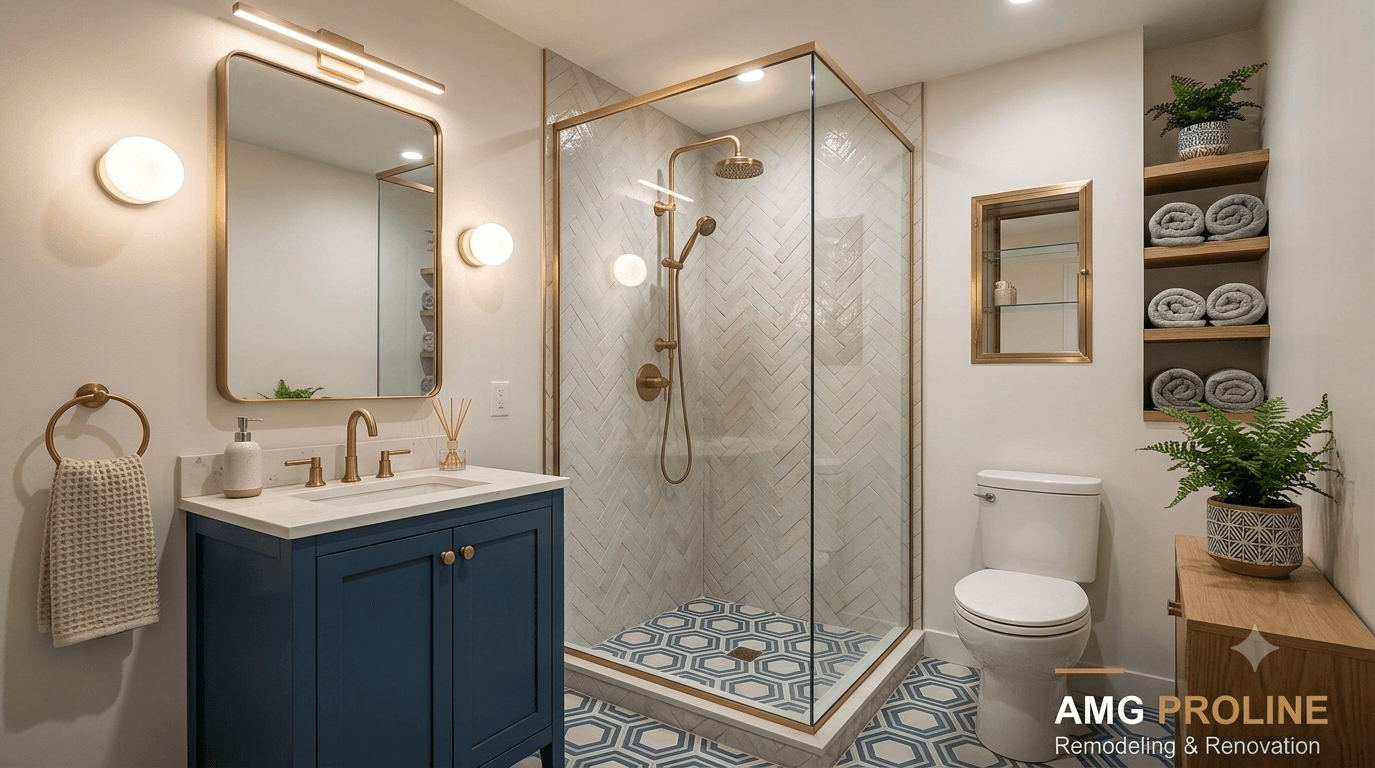
We get called out to look at a lot of bathrooms that failed fast. Grout that stained within a year. Tile that came loose at the edges. A musty smell that will not go away no matter how often the fan runs. The homeowner almost always assumes the problem is the tile itself, the wrong grade, the wrong installer, bad luck. It almost never is. The tile is the last thing that goes on. The failure happened underneath it, months before the grout was ever mixed.
This is one of the most important things we can tell you before you hire anyone for a bathroom remodel: bathroom waterproofing, not the finish you pick, decides whether the room lasts two years or twenty. This post explains what actually goes wrong, why it is invisible until it isn’t, and what proper waterproofing looks like.
What’s Actually Behind the Tile
A shower or tub surround is not just tile stuck to drywall. Underneath the finish layer, there has to be a waterproof membrane, correctly installed and continuous, with no gaps at seams, corners, or penetrations like the shower valve and niche. Behind that, the substrate has to be the right material for a wet area, not standard drywall, which will absorb moisture and fail even behind a perfect membrane if the membrane has any weakness.
The shower floor is its own separate problem. A shower pan has to be sloped correctly toward the drain, typically around a quarter inch of fall per foot, so water actually leaves the space instead of sitting against the walls or pooling in low spots. Get the slope wrong, even slightly, and water sits where it should not, working its way behind the waterproofing over months and years. None of this is visible once the tile goes on. It is either done right the first time, or it is a slow-motion failure waiting to surface.
Why the Failure Takes So Long to Show Up
This is the part that misleads homeowners and lets bad work get away with it. Water intrusion behind tile does not cause an immediate, obvious problem. It takes time, often a year or more, for moisture trapped behind a failed membrane to work its way to the surface as staining, loose tile, or a persistent smell. By the time it shows up, the contractor who did the work is long gone, the warranty conversation is awkward at best, and the homeowner is left assuming it was just bad materials.
This delay is exactly why waterproofing is where corners get cut. A membrane installed incorrectly looks identical to one installed correctly on the day the tile goes up. There is no visual difference, no immediate consequence, and no way for a homeowner to inspect it once it is covered. A contractor cutting corners here is betting that the problem surfaces well after the job is paid for and the crew has moved on. It is one of the easiest places in a remodel to cut a cost that nobody will notice for a year.
Why We Refuse to Cut This Corner
This is exactly why waterproofing is the one place we will not compromise, regardless of what a client’s budget conversation looks like. We go into more detail on that stance specifically in why we won’t cut corners on waterproofing even when a client wants to save. The short version is that steering a tight budget away from waterproofing is the single worst place to save money in a bathroom, because it turns a five-year remodel into a two-year remodel, and the cost of tearing out and redoing a failed shower dwarfs whatever was saved.
We build every shower and tub surround on properly sloped pans and continuous waterproofing before a single tile is set. It is not the most visually impressive part of the job, and it is the part clients see the least of, but it is what our reputation is actually built on, because it is the part that determines whether the visible work still looks good in five years.
What This Means If You’re Hiring Someone Else
If you are getting bids from other contractors, ask specifically about the waterproofing system and the pan slope method they use. A contractor who cannot answer clearly, or who brushes past the question to talk about tile options, is a red flag. This is also a place where price differences between bids often hide real differences in scope. A cheaper bid may simply be skipping steps that do not show up until the tile is already installed.
This connects to a broader pattern worth understanding before you hire anyone for a remodel. Vague bids that leave out the parts nobody sees are how low numbers turn into high final costs, and it works the same way in a kitchen as it does in a bathroom. We cover the mechanics of that in why we quote fixed written prices when most contractors won’t, because an honest, detailed estimate should account for waterproofing explicitly rather than folding it into a vague labor line.
Older Homes Add Another Layer
In older Chicago-area homes, the stakes are even higher, because bathrooms here often sit on top of aging plumbing and framing that was never built to modern wet-area standards. When we open up an old bathroom, we frequently find prior water damage that was tiled over rather than repaired, which means the room was failing again before the new tile was even finished. We talk through what we typically find behind the walls in these older bathrooms in what we find behind the walls in Chicago’s older bathrooms.
This is why a proper remodel in an older home starts with actually looking at what is there rather than assuming a clean slate. Skipping that step and waterproofing over an existing problem just resets the clock on the same failure.
How to Spot a Bathroom That Was Waterproofed Correctly
You will not be able to inspect the membrane once the tile is on, which is exactly the problem. What you can do is ask the right questions before hiring: what waterproofing system is used, how is the shower pan sloped and verified, and is the substrate rated for wet areas. A contractor who has clear, specific answers has clearly done this correctly many times. One who gives you a vague answer about using good materials has probably not thought about it as carefully as they should.
You can also look at how long a contractor’s past work has held up. A company that has been doing this for years and can point to bathrooms they built five, ten, or fifteen years ago that still look and perform well has proven their waterproofing works, not just their tile setting.
The Bottom Line
When a bathroom fails early, the tile takes the blame, but the tile was never the problem. Waterproofing and pan slope, the parts you cannot see and cannot inspect after the fact, are what actually determine whether your remodel lasts. It is the least glamorous part of the job and the most important one, and it is exactly where we spend the most care, whether we are working on a bathroom in Orland Park or a bathroom in Naperville.
If you want a bathroom that still looks and performs like new years from now, reach out through our contact page for a free estimate. You can see finished bathrooms in our project gallery or learn more about how we build at AMG Proline.
Written by the AMG Proline Team, licensed remodeling contractors serving Chicago and the surrounding suburbs since 2015.
Categories

Brewery Taproom Build-Out in Chicago: Floor Drains, Glycol Lines, Licensing Timeline and Budget
Quick answer: A brewery taproom build out in Chicago is driven by what happens under the floor and behind the bar: sloped floors and trench drains in the brewhouse, glycol-chilled draft lines from the cooler [...]

Med Spa Build-Out in Chicago: Treatment Room Layout, Electrical Loads and Real Construction Costs
Quick answer: Med spa build out cost in Chicago usually lands between about $80 and $250 per square foot for construction when you convert a space that was never medical, before equipment. A typical 1,200 [...]

Dental Office Build-Out Cost in Chicago: Plumbing, X-Ray Shielding, Equipment Rough-Ins and Timeline
Quick Answer A dental office build-out in Chicago typically costs $185 to $325 per square foot for construction, which works out to roughly $280,000 to $490,000 for a 1,500 square foot practice and $640,000 to [...]

Wet Room Bathroom Design in Chicago Homes: Layout, Waterproofing and Cost
Quick Answer A wet room bathroom in a Chicago home typically costs between $18,000 and $48,000 for a small to mid-size bathroom, and $45,000 to $75,000 or more for a primary bath. The price is [...]




